







Caregiver
Automobile Transportation
Automobile Repair and Maintenance
Building Cleaning
Agriculture
Accommodation Industry
Airport Ground Handling
Construction

Japan is looking for Specified Skilled Workers!

Would you like to bring your talent to life in Japan?
In April 2019, Japan established a new status of residence, “Specified Skilled Worker (SSW)”, to welcome capable specialists from overseas countries to work in certain Japanese industrial fields, to function as workers ready to take on jobs without prior training. This page will introduce information for those that want to play an active role in Japan by making use of the expertise and skills they have cultivated so far.

What is the SSW ?

"Visa" and "Status of Residence"

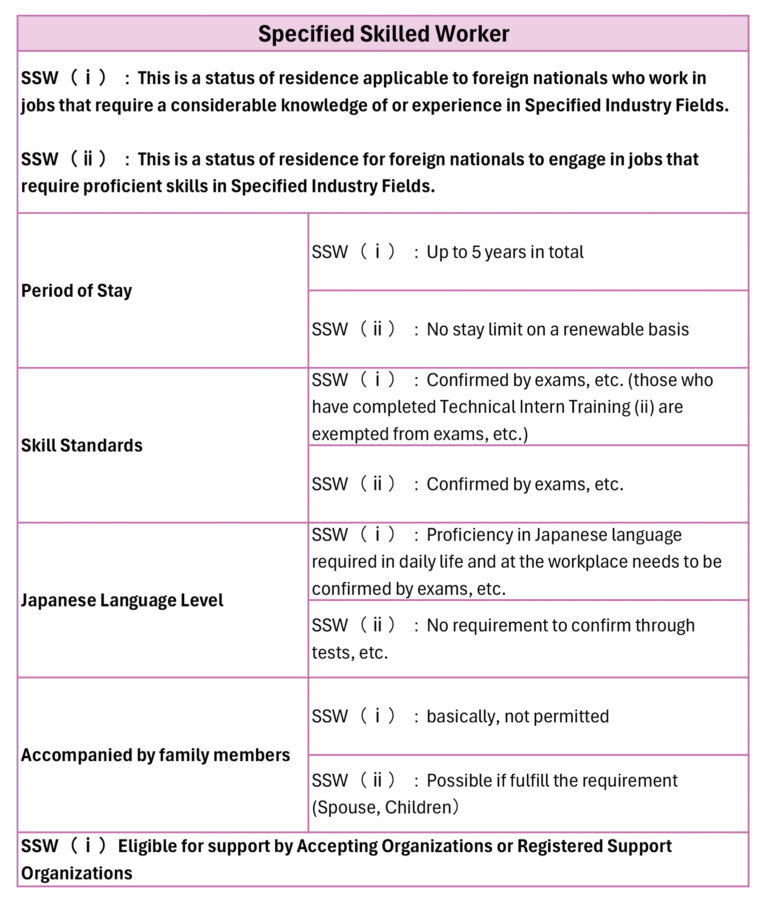
As a general rule, foreign national who intend to entry into Japan must acquire a “visa” at the embassy of Japan (an organization of the Ministry of Foreign Affairs, the headquarters for Japanese Government representatives serving) in a foreign country, but this does not mean that you are guaranteed entry into Japan if obtaining a visa. When you arrive in Japan, you need to undergo the necessary examination by the Immigration Services Agency of Japan at the airport and acquire a “Status of Residence” according to the activity you are trying to conduct in Japan. In light of this, acquisition of “visa” and “Status of Residence” are separate procedures that fall under the jurisdiction of different organizations. The SSW introduced on this page is a type of newly established “Status of Residence”.The SSW has two types, “Specified Skilled Worker” – (i) and (ii) .

Features of SSW

Those who can work in Japan as a SSW must be over 18 years old in a good health, have the necessary occupational skills to work immediately without receiving any particular training.
There is another program called “”Technical Intern Training””, which aims toward providing international contributions by having workers share skills and knowledge that they acquired through on-the-job training in Japan throughout their home country after returning. Those who have satisfactory completed Technical Intern Training are able to switch their status of residence to SSW (ⅰ) in the same field without taking occupational skill exams and Japanese proficiency tests. Refer to the following chart for the main differences between SSW (ⅰ) and (ⅱ).

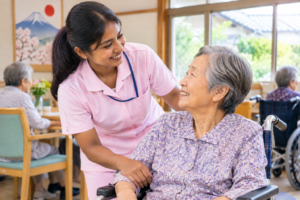
Caregiver

Provide daily care and support to elderly residents, including assistance with bathing, dressing, eating, toileting, mobility, and other daily activities. Help maintain a safe, clean, and comfortable living environment while communicating kindly with residents and care staff.

Automobile Transportation

Transport passengers or goods safely and efficiently, follow Japanese traffic rules, maintain vehicle cleanliness, perform basic vehicle checks, and ensure timely deliveries or arrivals.

Building Cleaning

Clean and maintain buildings, offices, and commercial facilities by sweeping, mopping, vacuuming, cleaning toilets and windows, and ensuring a hygienic, safe, and comfortable environment.

Agriculture

Plant, grow, harvest, and pack crops or vegetables. Maintain fields and farming equipment, follow agricultural safety procedures, and help ensure high-quality agricultural products.

Automobile Repair and Maintenance

Inspect, repair, and maintain cars and other vehicles. Perform oil changes, tire replacements, brake checks, and routine servicing while following Japanese safety standards.

Airport Ground Handling

Handle passenger baggage, load and unload cargo, guide aircraft on the ground, and assist with aircraft turnaround operations while following airport safety procedures.

Construction

Perform construction work such as building, roadwork, concrete work, and site preparation. Operate tools and equipment safely while following Japanese construction standards and safety procedures.

Accommodation Industry

Assist with hotel operations, including guest reception, check-in and check-out, room cleaning, bed making, and guest services while maintaining cleanliness and providing excellent customer service.

How Much Can You Earn in Japan?

Choose a job and adjust your working hours to estimate your gross salary. Plan your next career step with confidence.

Calculate your salary

These are sample inputs only. Enter the hourly wage shown in the actual job offer. Overtime rules and premiums depend on applicable law and the employment contract.

ESTIMATED GROSS PAY
Estimated monthly salary
¥211,200
Estimated annual salary¥2,534,400
Regular monthly pay¥211,200
Estimated overtime pay¥0
Working hours per month176 hours

Gross estimate before tax, pension, health insurance, accommodation and other deductions. Actual take-home pay may be lower. This calculator is an illustration.

I G E S International Foreign Employment Agency PVT LTD · Salary figures vary by employer, prefecture, role, experience, schedule and allowances. Always confirm salary and deductions in the written employment conditions.

Source: Ministry of Foreign Affairs of Japan website. URL: https://www.mofa.go.jp/ Accessed: 2026-08-05.